
How the Burlington Liars' Club Started
CREATOR AND FIRST PRESIDENT OF BURLINGTON LIARS' CLUB WAS NOT OTIS HULETT - WOULD YOU BELIEVE IT?

Over the years, former newspaper man and Burlington resident, Otis C. Hulett, has generally been credited with being the person responsible for creating the world famous Burlington Liars' Club. According to the following article, which appeared in the Standard Democrat of December 13, 1940, however, the truth may "lie" elsewhere.
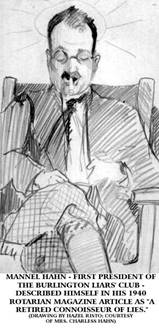 In the article, Mannel Hahn, who lived in Burlington in the late 1920s into 1930, tells the story of the origin of the Burlington Liars' Club. As will be seen, the Liars' Club -- which some say is one of Burlington's chief claims to fame -- had almost accidental beginnings.
LIE WORK OF ART SAYS HAHN IN ROTARIAN
Gives History of Organization And Growth of Famous Local Liars' Club
Mannel Hahn, former resident of this city, who now (Dec. 1940) resides at Maywood, Illinois, and is a district governor of Rotary, contributed the following article on the organization of the Burlington Liars' club which is published in the December issue of the Rotarian magazine:
New Years Eve in an American newspaper office . . . the staff dull, dispirited, cheated of the gaiety of the holiday, yet doomed to spend the evening writing about the gay spirits displayed by others, their gloom lightened by juicy tidbits of auto crashes, fires and other catastrophes. That is the picture as it used to be.
Today all is changed. The reporters, sub-editors, copywriters, rewrite men -- even the misanthrope who writes the joy-and-gladness "tear jerkers" -- are all pepped up, waiting for the flash from the telegraph editor that IT has come. When it does, they all jam about him for their New Years chuckle.
IT is the annual prize-winning lie of the Burlington Liars' club, announced each New Years Eve by the Burlington Liars' Club, Inc.
From the raw material of the lie to the corporation that annually puts it into circulation, the whole business is so typically American -- and it all started so innocently!
Christmas, 1929, was doubly disappointing to many of us, and especially to me. I was living in Burlington, Wisconsin, and I was free-lancing -- a euphemism for starving genteelly. As correspondent for the Milwaukee Journal and the Chicago Daily News, I received a limited supply of cash each month for sending in a total of so many inches of such tidbits as "Hiram Blotz, of 17884 West Evergreen Terrace, was arrested here today for speeding. He was fined $2 and costs."
Unfortunately, Hiram and his ilk had been disgustingly law-abiding and there were no fires, murders, or train wrecks to swell the total of "space" to my credit. It was time for drastic action, what with Christmas bills arriving, so I sat down and concocted a fantasy of the non-existent meeting of an ephemeral "liars' club" and its award of a medal. Typing this out in two distinct styles, I mailed one to the Journal and one to the News, marking them as "A-copy," or advance stories for release on January 2 -- both being afternoon papers with no New Years day edition.
There was a basis of fact for my yarn. Every morning a group of quite reputable persons met in the police station and swapped stories. There were a couple of lawyers, the older and retired men of the city, the police chief, an officer or two, and the two newspaper men -- Otis C. Hulett, of the Racine paper, and myself. Telling "tall tales" was our daily pastime. They ranged from actual experiences in the World war and in sailing the seven seas -- we had a retired captain as one of our regulars -- to yarns taxing the imagination of the teller and the credulity of the listener. Any particularly vivid "lie" was sure to rouse a cry from "Pink" Schenning, a red-headed policeman, of "Give him the medal!"
The medal was another figment of the imagination. According to the story, there had once been a leather medal for the best lie, but it had been -- so the legend ran -- buried with its most consistent winner.
However, the lie I sent to the Journal and the News was dressed up deluxe with a solemn story of the annual contest before a jury of newspaper men and lawyers -- "their work making them competent to judge lies." The award, my copy went on to say, was given to our retired sea captain, Anthony Delano, for his story of a whale he once passed that was three miles long. Naturally, the judges asked for proof. The captain furnished it: the ship had come abeam of the whale's tail just at two bells of the morning watch, as the log was being heaved. The ship was running three knots an hour. At four bells, which is an hour later, the log was heaved again, and the speed was constant. And as the ship was just then drawing abeam of the whale's head, it had taken a run of three miles to measure the whale, which was therefore three nautical miles long. Q. E. D.
For a runner-up to this yarn I offered the lagniappe of a spontaneous lie told by Police Chief Frank Beller. He, when asked for an entry in the contest, said "But I cannot tell a lie!"
The next day I received a call from the Journal. They were delighted with the story, and wanted to send their cameraman down to take pictures of the formal award of the medal on New Years Eve. I persuaded them to leave it to me. Now, my story must stand! I got hold of Charles Warner, the photographer, Chief Beller and Captain Delano, and had private pictures taken of the award. From my treasures I produced a medal I got in South America, and I had a photograph made showing Chief Beller pinning this showy badge on the coat of Captain Delano.
But this photo spoiled my "exclusive" on the story, for the Chief told Otey Hulett, my friendly rival about it, and Otey demanded my yarn so that our stories would jibe. In the interest of factual fiction, I gave him the whale yarn, but forgot about the runner-up story. And so it came about that three papers, instead of two carried the first lie January 2, 1930.
This -- and the checks to come -- was all we had counted upon. But we had not reckoned on the Great American Urge for Exaggeration. A news service picked up our story and, boiled down to two succinct paragraphs, put it on the wire. A week later a clipping arrived from a Burlingtonian in Florida. The next day brought clippings from New York and Los Angeles. Burlington and its modest liars were NEWS. It gave us a lot of chuckles; and the United Press even hired me for a weekly column of lies. But three months later I got a real job in Chicago and removed to a city suburb.
A year after my magnum opus had been unveiled to the world, I was invited back to Burlington for a New Years Eve party, and was just getting ready to leave when the Chicago Tribune called. Was I the "president of the Burlington Liars' club?" It was the first I had heard of such an office, but a quick thought assured me I had invented the club, so could also invent its president! I tried to get the reason for the question, but they hung up. So the first thing I did on arriving at Burlington was to call Otey.
 It seems that he, as myself, had forgotten all about it except for an occasional jocular remark, but the week before all three major news services had called him and asked for the annual decision of the judges. Caught short, he had remembered my runner-up of the year before, and had awarded the medal to Chief Beller for his Washingtonian effort. Pressed for more detail, he had elected me president, himself vice president, and "Pink" Schenning as secretary-treasurer.
Now the great American habit of tall stories is ingrained. Particularly so in the more rural and, therefore, less hurried locale, where a good lie is esteemed as an exaggeration, and not as a means to any end except a grin or a guffaw. Witness the legend of Paul Bunyan and his big blue ox Babe, which was seven ax handles between the eyes -- or else 42 ax handles and a plug of tobacco -- depending on which school of thought you accept. Recent research scientists have explained that the two measurements are really identical -- one of Paul's ax handles being just a trifle longer than six present-day ones. Remember, too, that while Burlington is too far south to be a lumbering center, its older citizens had often gone north in logging days to make up part of a camp crew. So the Paul Bunyan myths were very real to the older men -- I have heard Fred Itzin say of the first snowfall of the year, "Well, Paul's knocking ashes out of his pipe!"
 The Burlington Liars' club gave an honored place to the Great American Yen for Overstatement. There was a demand that artistic liars everywhere be allowed to compete. And who were the astonished holders of the offices of the Liars' club to deny the waiting world? However, I was not available, and it seemed wise to have at least three, so I was informed I was "president emeritus," and the perfect third party was found. It was Lawrence J. Stang, whose "variety store" had all the traditional characteristics, save one, of the village meetin' place -- a long, lank proprietor with spectacles on his nose, and a full-bellied wood or coal-burning stove. The missing item, of course, is the cracker barrel. So, Larry, Pink and Otey formed a partnership and moved from the harsh cleanliness of the police station to the comfortable, photogenic atmosphere of Larry's big stove.
 Inexorably, another Great American characteristic was not creeping but galloping in: Organization. The Burlington Liars' club was being organized. Lies accompanied by a return envelope with postage prepaid were acknowledged by membership cards. A real medal emblematic of the United States championship, was produced, with a large plaque for insertion of the winner's name each year.
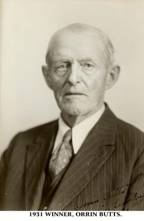
The 1931 award, the third, left Burlington, but not very far. Another talented Midwesterner succeeded: Orrin Butts, of Bay City, Michigan. Orrin was the hero of an emergency operation, in which a farmer, devastatingly gored by a bull, was reviscerated with the stomach of a close-to-hand sheep. The farmer recovered, but not long after grew horns, and after the second year sprouted wool all over, so that thereafter he sheared 30 to 40 pounds each spring.

In 1932 the title swung west, to Denver, Colorado. This lie conforms to all the general canons of exaggeration with a quick kick at the end, but it has elements of eternal greatness. Phil McCarty told how his cat lost a foreleg. The cat having been a master mouser, out of gratitude Phil fashioned a old-style peg to the stump. After Kitty had accustomed herself to the new limb, imagine Phil's surprise when her mousing score increased. Instead of the former use of claws, Kitty developed a new technique: she hid in the shadows and brained the mice with her peg leg, used as a club!
 The flood of entries of which the cat was the cream -- to mix a metaphor -- was the push that led to a more formal partnership, and in the following year the partners decided to incorporate -- and thereby gained another member. He is Gilbert A. "Gib" Karcher, an attorney-at-law, who is as rotund as Larry is lank. His addition is a concession to my dictum that the judges should be lawyers or newspaper men, experts per se in the detection of lies. The incorporation took place in 1934 after the 1933 selection had been made in the studios of the National Broadcasting company and sent out over a nation-wide hook-up.
Since that time there have been few changes in personnel in the inner circle of the club. H. W. Schenning, one of the original group and probably more than any other the inspiration of my first effort -- for material purposes only, rather than  artistic -- fell a victim to his profession of policeman when he has killed in arresting a suspected bank robber. Recent advices from Burlington tell me that the pot-bellied stove has fallen a victim to progress and has been replaced by modern, though less picturesque, heating.

What manner of men and women participate in this annual contest? Yes, women; for they enter in large numbers each year, though few reach the finals and only one has held the ephemeral title of "champion" for a year. Well, they are a cross section of America in many ways, from the social top to bottom, from the geographic East to West and North to South. There is no guerdon in being the best liar, for even the lies that are entered become the property of the club, and sometimes are published in booklets of the best, or in times past in a column in a humorous paper, and to make a broadcast of the best.
The only reward is the mental fillip of being the Best Liar, acclaimed as such, and a membership card -- though the costs of printing, postage, and the like, have brought about a small charge for the visible token.
What kind of lies come in? Only a few rise above what might be called "type lies." Practically every one entered conforms to the pattern of exaggeration. Most of them are duplicates in structure of age-old lies. One of the favorites is some variant on the snake that struck a fence post or hoe handle, which then grew so large that 243 cords of wood came from it before it was down to its original size again. Another is some variant of the Grand Canyon guide who fell from the top of the canyon while wearing rubber boots. He lit on his feet and bounced back up, thus saving his life -- but he kept right on bouncing , so after three days they had to shoot him to keep him from starving to death.
Others fall definitely into the Paul Bunyan saga: such as the fish so large it took 48 hours for the water to fill the hole in the river when it was pulled out; or the railroad locomotive so large that a man who fell into the water tank next showed up in the gauge glass; and, very definitely, the story  of the wells in Kansas which, after a severe dust storm, stuck out of the ground so far that the farmers roofed them over for silos. This is a direct borrowing of Paul's well in Dakota that stuck up 634 feet after a storm until he sawed it down and split it up into post holes, which he sold to the farmers in Missouri for more than his lumber cut yielded.
 One thing is evident -- and a matter of pride for America: all the stories are clean, parlor stories!
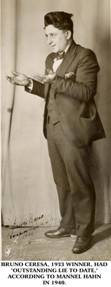
Out of the whole crop, the 1933 winner seems to me -- a retired connoisseur of lies -- the outstanding lie to date. It was the effort of Bruno Ceresa of Langeloth, Pennsylvania. His grandfather, related Bruno, had a clock so old that no one knew how long it had been in service, but there was a hole through the back of the case where the shadow of the swinging pendulum had worn through!
- - - - -
Mannel Hahn, author of the above article, was a brother of Mrs. Dorothy (Charles) Rohr, a long-time resident of Burlington, who after her husband's untimely death, married E. Perry Larson. Mr. Hahn's wife, Nancy Coonsman Hahn, was a noted sculptress. During the time the Hahns and their son, Charless, lived in Burlington, Mrs. Hahn created the brass plaque that the Burlington Historical Society erected just east of the White River bridge on Highway 11 to mark the site of the Mormon settlement at Voree.
 Mr. Hahn, who resided in Winnetka, Illinois, at the time of his death in January 1955, was an Air Corps captain in World War I and a member of the Office of Strategic Services in World War II. Hahn's choice of Bruno Ceresa's story of his grandfather's clock as the "outstanding lie to date" in the 1940 Rotarian article demonstrated the accuracy of his self-description as a "connoisseur of lies" when that story was picked in 1954 as the best lie of the first quarter century of the Liars' Club's existence.
Otis Hulett, Mr. Hahn's friendly rival and 1929 "co-conspirator," is often credited with creating the Liars' Club. Undoubtedly, the club would not have become nationally and then internationally known without Mr. Hulett's efforts.
But Mr. Hahn's Rotarian article and Mr. Hulett's designation of Mr. Hahn as the first president of the Burlington Liars' Club, as well as other early writings on the club in which Mr. Hahn is mentioned, including Mr. Hulett's story on the 1930 contest and an article that Mr. Hulett wrote for The Minneapolis Journal Sunday Magazine in August 1934, give credence to Mr. Hahn's claim to have been not only the first president, but also the creator of the Burlington Liars' Club.
INTERESTED IN MORE ON THE BURLINGTON LIARS' CLUB?
1. Visit the Burlington Liars' Club website.
2. Visit the Burlington Historical Society's Museum on Sunday afternoons.
3. Walk the Tall Tales Trail when you’re in Burlington. Start at the Chamber of Commerce office at 113 E. Chestnut Street (in the “Loop”) and pick up the trail map. Then visit the many businesses, stores, and municipal buildings around the city, view the bronze plaques, and enjoy the unique brand of American humor, featuring some of the championship lies.
4. When at the Chamber of Commerce office, purchase the current book of “lies,” containing fibs from the 70+ year history of the club.
INTERESTED IN TRYING YOUR LUCK IN THE UPCOMING ANNUAL CONTEST?
If you or someone you know would like to become an official card carrying member of the Burlington Liars' Club, send $1 and your tall tale to:
Burlington Liars' Club
P.O. Box 156
Burlington, WI 53105
or
Send an email to: championlies@gmail.com and include:
Your Name, Your Address and Your Tall Tale!