|
|||||||||||



BURLINGTON HISTORIAN
September 2016
BURLINGTON HISTORIAN September 2016 | ||||||||||||
|
|
BURLINGTON HISTORIAN September 2016 | ||||||||||||
|
|||||||||||
|
|||||||||||
|
||||||||||||||||||||||||||||
 |
||||||||||||||||||||||||||||
|
||||||||||||||||||||||||||||
|
|
||||||||||||||||||||||||||||
| A- | A | A+ |
 |
Home Contents Search Visit Us Join Us Related Sites Notices Contact Us |
 |
|
||
 |
|||
|
|||
 Burlington History | | | Society History | | Newsletters | | Articles | | Photo Collection | | On-line Records | | Publications for Sale |
| A- | A | A+ |
|
Home Contents Search Visit Us Join Us Related Sites Notices Contact Us |
|
|
|
||
|
|||
|
|||
| Burlington History | | | Society History | | Newsletters | | Articles | | Photo Collection | | On-line Records | | Publications for Sale |




September 2010
| Renovated Museum To Re-Open
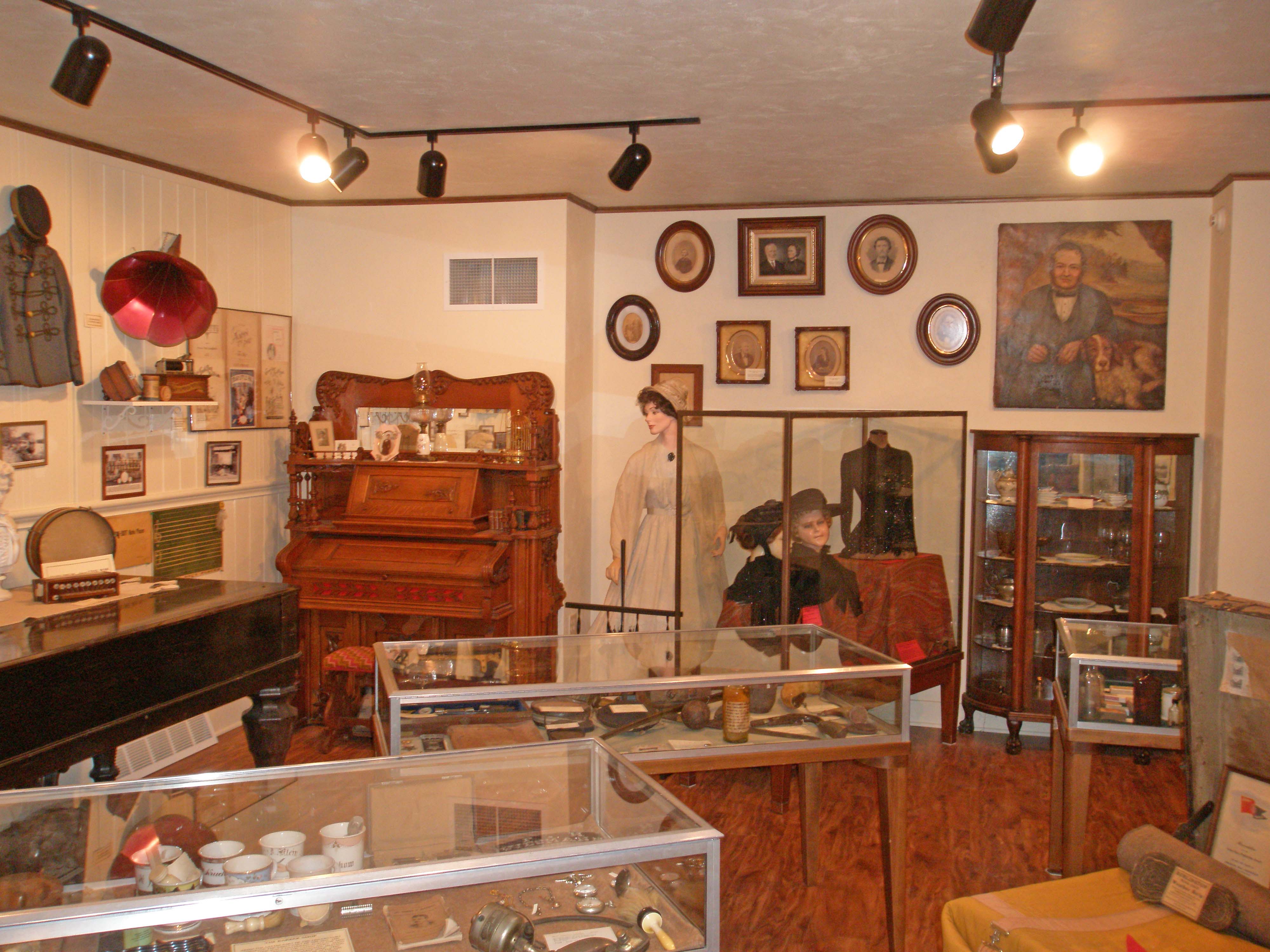
Saturday, October 9 The renovation of the Society's Museum is nearly completed. After being closed for three years, the Museum will be re-opened on Saturday, October 9, 2010, at 1:00 p.m. The board of directors is planning a short program at 1:30 to mark the occasion. Refreshments will be served. The Museum was closed on October 8, 2007, to allow for interior
renovation and the installation of a second floor. The shelving and
artifacts in the basement were rearranged; the displays on the main
floor were dismantled; the computer and office material was moved to
the kitchen; and many of the larger artifacts, most of the display
cases, and some paper records were stored off-site to allow the
workmen to have the access needed to complete the job. Stelling & Associates Architects Ltd. drew the plans and specifications for the renovations. The general contractor was Cramer Construction. Keith Zwiebel assisted Craig and Jeff Cramer on the general and carpentry work. Hard Rock Sawing and Ehlen Masonry did the concrete work that was needed in the basement to provide the proper footings for the supporting posts. Bonanza Heating re-positioned ductwork and installed a second-floor heating and air conditioning unit. Gauger Plumbing and Heating installed first-floor restroom facilities and a utility sink. Plastering of the ceiling, walls, and support posts was done by Mitchell Plastering. The interior painting was done by the T. LaRue Painting Co. Kuchenbecker Electric did the necessary electrical work, including the rewiring of the lights in the display cases. Ketter's Flooring laid the new floor on the main floor and carpeted the second floor and stairways. The board of directors decided that some outside work also needed
to be done on the Museum building. It hired the Burlington Roofing
Co. to replace and upgrade the roof, which had deteriorated badly
over the years. After the roofing was completed, the wooden and trim
portions of the exterior were painted by JAMCO Painting. |
| President’s Message
Need a barber? Not many in Burlington any more. Years ago, barber shops were all over town. Now, we have "salons" on almost every block in town. Being a conservative type of person most of my life, I think about the routine ways we lived our lives four or five decades back. Enter the barber shop and you would sometimes see three or more barbers on duty, plus a young boy willing to shine your shoes. Need gas? Pull in the driveway of the gas station and run over a hose that rang a bell and out popped an attendant or two. Fill’er Up? "Yes, and please check the oil." For the people that grew up in Burlington, you would get quite a memory trip going to our society website and running a search in the "Burlington Events" section of our searchable databases. In the "Keywords" area type: Barber Shop or Gasoline. Many names out of the past will pop up – some that you may recognize. Times do change, sometimes for the better. It sure is fun though to look back and remember "the way things used to be." Dennis Tully Storage Building to be Constructed Near Whitman School With the Museum's storage area rapidly filling up with artifacts, photographs and negatives, historical and genealogical records, supplies, and other material; with some of our furniture items and display cases still in storage at the hospital warehouse; and with several people wanting to donate large items that we have been unable to accept because of the lack of storage space, the board of directors has decided that the time is right for constructing a storage building. We approached the city with a request to construct an approximately 30 by 40 foot, one-story storage building on land in Schmaling Park near the Whitman School building on Beloit Street. We also approached NEL Frequency Control to request permission to access the storage building by using its parking lot next to the park if needed. Both granted the permission needed to proceed with the project. The one-story wooden building, with a peaked roof, will sit on a concrete slab and have a large overhead-type entry door and one service door. There will be no windows. An electrical line will extend from the Whitman School building to the storage building to provide electricity for lighting and for operating the overhead door. We don’t yet have a firm cost estimate, but believe the project will run in the neighborhood of $15,000 to $20,000. Two New Members on Board of Directors Peter Hintz, second district alderman and aldermanic representative on the city's Historic Preservation Commission, and Stephanie Rummler, social studies teacher at Karcher Middle School, have joined the Society's board of directors. We look forward to their getting involved in carrying out the mission of
the Society. Welcome aboard! |
Church Picture Recalls Early Painting Job| Fred Henningfield wrote the following letter to the Standard Democrat
in December 1951. It was printed in the paper's January 4, 1952, issue. | |
In looking through the Standard Democrat this week, I saw a picture of
the old Plymouth church that brings back memories of sixty years ago.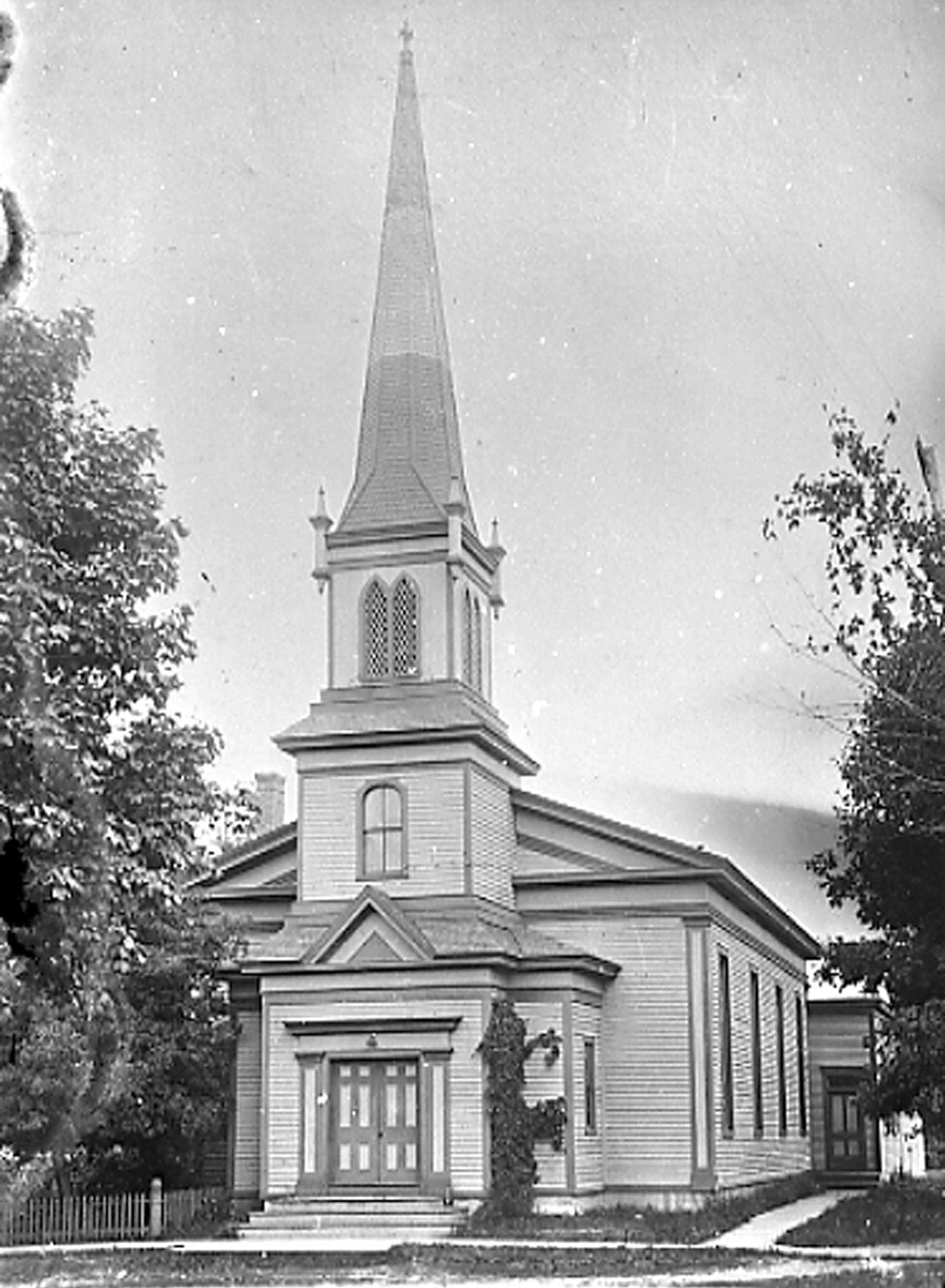 (The Plymouth church, as shown in the accompanying photo, was a wooden
building in 1891 when Henningfield helped paint the steeple. The wooden
building was razed in 1902 to make way for the brick church building.)
(The Plymouth church, as shown in the accompanying photo, was a wooden
building in 1891 when Henningfield helped paint the steeple. The wooden
building was razed in 1902 to make way for the brick church building.)
It was back in 1891 that I worked for the late Richard Weygand, learning the painting trade. I worked for him three years, the wages I received were fifty cents a day the first year, seventy-five cents a day the second year, and a dollar a day the third year. That was for a ten hour day.
It was in the second year of my apprenticeship that Mr. Weygand took the contract for painting the Plymouth church. Working with us was Sherman Gillespie. We started the job at the top of the steeple. To get up there we built a scaffold on the roof, up to the belfry. From the platform we raised a three piece extension ladder, which reached almost to the top of the steeple.
I, being the lightest, went to the top and tied a rope around the steeple, to which a pulley was fastened. Hanging from the pulley was a swinging seat in which I sat and painted the street side of the steeple. Sherman Gillespie painted the other side from the ladder.
We had to go through this performance twice, as the church received two coats of paint. We had a lot of sidewalk superintendents watching us and advising us.
In those days Mr. Weygand’s shop was located on the site where the Nash Burlington Co. is now. We used to grind all our own colors with a hand grinder. This work was always a rainy day job. Mr. Weygand mixed nearly all of his paints. White lead sold at $5.00 per hundred, linseed oil sold at 35 cents a gallon and top wages were $1.50 a day for 10 hours work, but they were happy days.
Fred Henningfield, Lyons
Bells and Whistles
Bells and Whistles Play an Important Part In Life and are a Burlington
Tradition | |
Little do people realize the important part a whistle or bell plays in their lives. Stop to think now . . . do they or do they not automatically start and end the working day or the school day for you; inform you of deaths, marriages, or the commencing of church services? They do, but you no doubt have not realized the fact.
Let’s pause for awhile to analyze the whistle and bell system in Burlington.
Whistles
Let’s take the fire department’s whistle for example. This blast can be heard throughout the city. It is blown at approximately 6 p.m. not as a 6 o’clock whistle, as most people believe, but as a test of its working condition. This is very important because of its use for fire and rescue calls.
The whistle is blown every evening except Saturday and Sunday, by the man
working the night shift at the department. Either Charles Stang or Harry
Hathorn has this chore.
- - - - -
Harry Hathorn remembers the day when a steam whistle was used. That was during the days when the fire house was the old pumping station, with boilers galore. After this was changed, the city found that it was costing them $30 a day to keep 90 pounds of steam up at all times for the whistle, so the air horn was installed.
Fireman Charles Stang says this horn was used officially for the first time on the morning of the Orpheum theatre fire, Thursday, January 23, 1930. Both systems were used on that morning, when the mercury dipped to 15 below.
- - - - -
There is also a whistle at the Burlington Mills. Their whistle blows at 7 a.m., 12 noon, 1 p.m., and 4 p.m. Many Burlingtonians go through their entire working day following this whistle.
The correct reason, however, for this manually blown steam whistle is to tell the workman in Plants 1 and 2 when to begin and end their work day.
The whistle at the Mills has been blown approximately 40 years. The boilerroom fireman on duty at whistle time has the responsibility of blowing it. The whistle is timed fairly close to being correct, although there is nothing automatic about it and the human element of error is always present.
A whistleman’s job is not difficult so far as whistle blowing is concerned – it is the accuracy as to time that is so important. If he is a few seconds off, tho, the whole community is bound to realize it, for it can give uncertainty to the setting of watches, clocks, and the appearance of workers in offices, shops, and factories.
These are the only two whistles that blow in Burlington, although many residents living near the railroads try to keep time through train schedules and the familiar train whistle.
Bells
Next we analyze the bell system. This dates back to the beginning of churches in Burlington.
Bells were rung for every occasion and the people scheduled their lives with them. Strange as it may seem, announcements were made by the church bells. Births, marriages, deaths, funeral services, town meetings, etc. were relayed to the people by the ringing of the bells.
St. Mary’s church has the most active bell system in Burlington. The clock in the steeple is wound every morning and evening, so that each quarter hour it can automatically toll, with the sound being heard throughout the city.
The bell is manually tolled at 6 a.m., 12 noon, and 6 p.m. by Ollie Leber of Burlington. Leber has been ringing the bells for 27 years. (When World War II ended, Leber was a busy man, ringing the bells for hours.) Assisting him now is Bernard Brehm, who has been active as bell ringer for one year.
Beside the tolling of time, St. Mary’s bells call people to church by ringing before each service. Deaths are still tolled, and the bells ring out merrily for weddings.
If you listen closely every Saturday at 6 p.m., you will hear the bells of St. John’s Lutheran church ring. This denotes the ending of a working man’s week. The bell is also tolled for services, deaths, marriages, funerals, etc. The manually powered bell is rung by John Bauman, janitor.
Cross Lutheran church has a tradition of ringing its bell every Saturday evening at 6 o’clock. Fred Olson, of Burlington, has had charge of the bells for about 10 years.
Another of the nightly rung bells is at the Methodist church. Every evening at 6 o’clock, you can enjoy their ring. Also on Sunday mornings preceding church services, organ music is played for the city’s enjoyment. The bells and music are heard from an electrical device in the church.
At St. Charles, the chimes ring at 6 a.m., 12 noon, and 6 p.m. These chimes, newly installed, are electrically controlled. Services are always preceded by these chimes as are weddings and funerals.
Now that we have analyzed the whistle and bell system, don’t you honestly
agree that they do play an important part in your life? For workers,
throughout the city, the whistles call their attention to time. As for the
bells – many things in this world are based on tradition and the old
historic tradition of bell ringing is as beautiful as the church under the
bell tower and as the symbol within.
| "A Snapshot in Time"
Contributed by Priscilla Crowley I have a real hang-up when it comes to throwing away things like pictures, old cards, letters, Christmas ornaments that have seen better days, even items of clothing that were my very "favorites." Sometimes just the sight of an old cup and saucer or a post card from a long ago friend can evoke the greatest memories. Pictures are an especially good source for bringing back the good old days. There is one picture in particular that sticks with me. It’s really nothing special – it’s a picture of my Dad, my brother and sister and me. It was taken outside on the lawn when we lived in Lyons. Dad is crouched down and he has one of the twins on his right side, one sitting on the ground in front of him and I am standing on his left side. It wasn’t a posed picture with all of us in our "Sunday Best," just an ordinary kind of day picture. Dad was in his work clothes and we all looked sort of like what we were, kids who had been playing hard all day and hadn’t worried ourselves about whether we had dirt smudges on our clothes and sand in our shoes. We certainly wouldn’t have been deemed respectable looking enough to take out in public. When I see that picture it brings back that time and place as if it had happened yesterday instead of 50+ years ago. I can feel the green grass tickling the bottom of my feet, smell the sweet perfume of roses and freshly cut grass, feel the soft breeze blowing my hair and feel the warmth of the sun on my skin. I remember what it was like to be near my Dad who made you feel safe just by being there – nothing could go wrong as long as he was around. I remember what it was like when my brother and sister were young and active and into everything and always in constant motion – never a dull moment but so much fun! Our family was not unique – we had our ups and downs just like everyone else. I like to think that all those ups and downs made us what we are today. I know that for a while times were very lean and money was scarce. When you are going through hard times, you always think that no one else is going through the same thing. Looking back, I realize now that many of our neighbors and friends from school were going through the same kinds of things we were. I know that Mom and Dad worried about money constantly but to us – it was just the way things were. We had parents who loved us, food to eat, clothes to wear, plenty of space to run and have adventures in – what more could a kid want? One of the reasons I love that picture so much is because we all look so happy and in that picture we are forever young without the trials and tribulations of adulthood. You can tell that we all have on clothes that don’t quite fit, the dress I am wearing is too big and I can see that the shirt my sister is wearing is also a little big and the jeans my brother had on needed to be rolled up on the bottom so he wouldn’t trip on the pants legs. But all of that didn’t matter, that picture is a snapshot of who we really were – happy well-adjusted kids who loved and were loved and whose kid world was just about perfect. I had many different kinds of friends – ones from large families, ones from small families, even a few who were only children. We always envied the kids who had no brothers or sisters to contend with until you actually went to their house to play and saw how quiet it was with no other children to liven things up. My brother and sister might have been pains, but life was never dull, you could always count on one of them to do something to keep life interesting. That picture will always represent the bond between my brother, my sister, and me. It’s how we started out on the road to adulthood. Even though we are all grown up now and have moved in different directions from each other that picture is proof positive of that bond and I like to think that something of those children is still with all of us today. When my brother teases me about something or my sister asks me "remember when?" questions, I can see traits of those children from long ago. We may all have gotten taller and older but those long ago children still exist. Pictures are so much fun – they are a snapshot in time and can transport
you back to "remember when land." Take out some of those pictures and do
some time traveling from your armchair. Look for that long ago child in
yourself and others. Remember the shared laughter, the sun on your face, the
feel of the grass, the smells of the season, the shared memories, the way
the sky looked when the stars started to twinkle in the early twilight or
what sunrise was like on a beautiful summer morning. That long ago child
still exists for all of us – we just have to take the time to let him or her
out to play once in a while. |
Notices: Disclaimer and
Restriction of Liability
Send mail to
webmaster@burlingtonhistory.org
with questions or comments about this web site.
Burlington Historical Society
Last modified: 10/9/2011